
Instructions
Read the following scenario and answer the THREE questions that follow.
A pencil maker ships pencils in boxes of size 50, 100 and 200. Due to packaging issues, some pencils break. About the 20 boxes he has supplied to a shop, the following information is available:
* Box no. 1 through 6 have 50 pencils, Box no. 7 through 16 have 100 pencils and Box no. 17 through 20 have 200 pencils.
* No box has less than 5% or more than 20% broken pencils.
Following is the frequency table of the number of broken pencils for the twenty boxes: 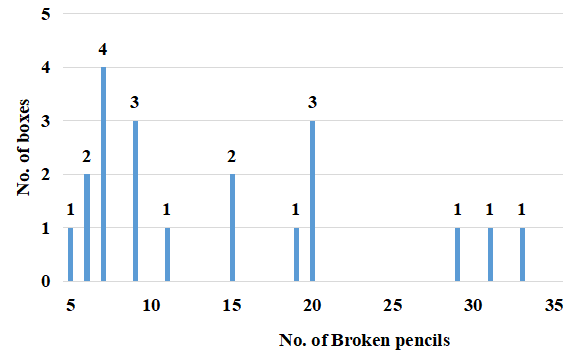
Question 12.
Which of the following can possibly be the sequence of the number of brokenpencils in Boxes 7-16?
Question Explanation
Boxes 7 to 16 contain a total of 100 pencils each. The minimum number of broken pencils the box can hold is 5 percent of the total pencils and a maximum of 20 percent of the total pencils.
5 percent of 100 = 5 and 20 percent of 100 = 20 pencils.
Hence the number of broken pencils must be in the range of 5 to 20.
The frequency of the different number of broken pencils is :
5 - 1
6 - 2
7 - 4
9 - 3
11 - 1
15 - 2
19 - 1
20 - 3
29 - 1
31 - 1
33 - 1
The boxes cannot contain 29, 31, 33 to be the number of broken pencils because they are beyond 20 percent.
Since boxes 1- 6 can contain only between 2.5 to 10 pencils. The remaining boxes which include broken pencils of numbers less than 10 must be a part of 7 - 16. Because boxes 17 - 20 cannot contain broken pencils of numbers less than 10.
Hence 7 - 16 must have 4 boxes that contain less than 10 broken pencils.
Going through the options :
Option A fails because this includes only 3 boxes with less than 10 pencils.
Option B fails because we only have 2 boxes with 6 broken pencils but this includes 3.
Option D fails because it does not include a box of 15 and a box of 20 pencils which can only be a part of boxes with 100 or boxes with 200 pencils. Since boxes 17 - 20 can include only one among 15 or 20 because 29, 31, 33 are a part of this group. Hence this case fails.
Option E fails because this includes 5 boxes with broken pencils less than 10 but this is not possible because this must exactly contain 4 boxes with less than 10 pencils.
Option C is a feasible case containing :
1-6 ( 5, 6, 6, 9, 9, 9)
7 - 16 ( 7, 7, 7, 7, 11, 15, 15, 19, 20, 20 )
17 - 20 (20, 29, 31, 33)
No video explanation yet — we're on it and uploading soon!
Master CAT Preparation with Previous Year Papers
Practicing CAT previous year papers is one of the most effective strategies for CAT exam preparation. By solving questions from CAT 2022 qadi-slot-1 and other previous years, you can understand the exam pattern, difficulty level, and types of questions asked in the Common Admission Test.
Why Practice CAT Previous Year Questions?
- Understand Exam Pattern: CAT previous papers help you familiarize yourself with the question format, marking scheme, and time management required for the actual exam.
- Identify Important Topics: By analyzing CAT solved questions from multiple years, you can identify frequently asked topics and focus your preparation accordingly.
- Improve Speed and Accuracy: Regular practice of CAT previous year papers enhances your problem-solving speed and accuracy, which are crucial for scoring well in the exam.
- Build Confidence: Solving CAT previous year questions builds confidence and reduces exam anxiety by making you comfortable with the exam format.
How to Use CAT Previous Papers Effectively
- Solve Under Exam Conditions: Attempt CAT previous year papers in a timed environment to simulate the actual exam experience.
- Analyze Your Performance: After solving each CAT previous paper, analyze your mistakes and identify areas that need improvement.
- Review Solutions Thoroughly: Study the detailed solutions and explanations provided for each question to understand the correct approach and methodology.
- Focus on Weak Areas: Use CAT solved questions to identify your weak areas and dedicate more time to improving them.
CAT Exam Sections Covered
Our comprehensive collection of CAT previous papers covers all three sections of the exam:
- VARC (Verbal Ability & Reading Comprehension): Practice reading comprehension passages, para jumbles, and other verbal ability questions from CAT previous years.
- DILR (Data Interpretation & Logical Reasoning): Master DI and LR questions with detailed solutions from CAT previous year papers.
- QA (Quantitative Ability): Solve arithmetic, algebra, geometry, and other quantitative ability questions from CAT solved papers.
Additional CAT Preparation Resources
Looking for more CAT preparation materials? Explore our comprehensive collection of:
- CAT Previous Papers Archive - Access questions from multiple years and slots
- CAT 2022 qadi-slot-1 Solved Solutions - Complete slot-wise solutions with explanations
- CAT Preparation Courses - Enroll in structured courses for comprehensive CAT preparation
Note: Regular practice of CAT previous year papers, combined with a structured study plan, is essential for achieving a high percentile in the CAT exam. Make sure to solve questions from all sections and review the solutions thoroughly to maximize your preparation effectiveness.